
What Is a PET Sheet Extrusion Line?
A PET sheet extrusion line converts PET resin or recycled flakes into continuous flat sheets used for thermoformed food packaging. The right configuration directly determines your energy cost per kilogram, sheet optical clarity, and intrinsic viscosity (IV) retention — the three metrics that define profitability in food-grade sheet production.
A PET sheet extrusion line is an integrated production system that melts, degasses, filters, and calenders polyethylene terephthalate (PET) raw material into flat sheets — typically for downstream thermoforming into food containers, blister packs, or punnets. Modern lines handle both virgin APET, recycled rPET, and CPET variants through single-screw or twin-screw configurations.
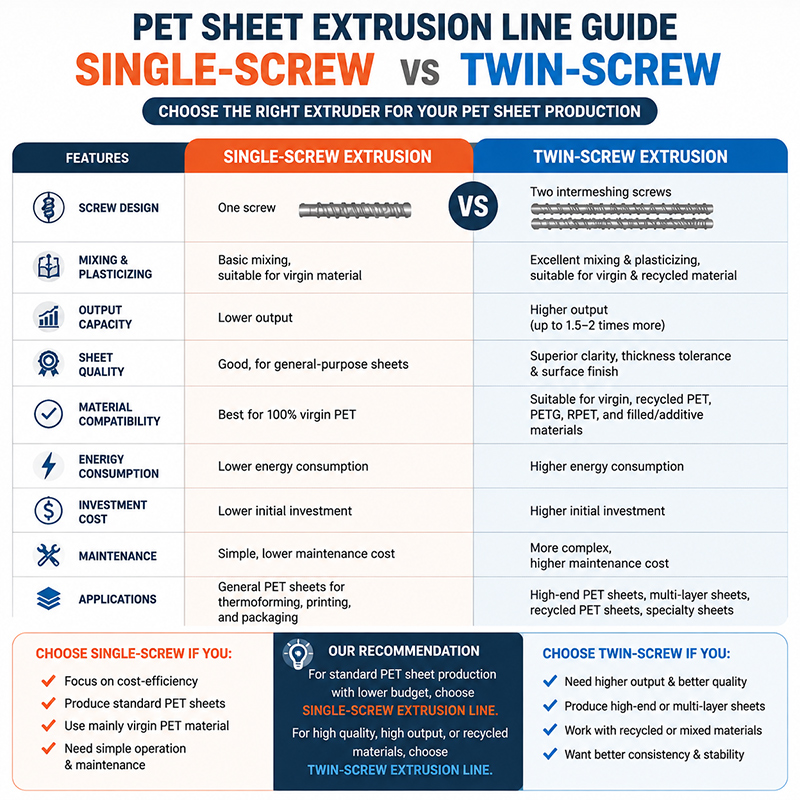
Single-Screw vs. Twin-Screw: Core Technical Comparison
The primary decision in selecting PET sheet machinery revolves around screw architecture and melt degassing capability. The table below summarizes the key differences:
| Technical Parameter | Single-Screw (Pre-Drying) | Twin-Screw (Direct Degassing) |
|---|---|---|
| Raw Material Suitability | 100% virgin PET / clean flakes | Up to 100% bottle flakes / rPET |
| Pre-Drying Requirement | Mandatory (dehumidifying + crystallization) | Not required (high-vacuum system) |
| Energy Consumption | 0.35–0.42 kWh/kg | 0.20–0.25 kWh/kg (up to 40% savings) |
| IV Loss Control | ≤ 0.02 dL/g | ≤ 0.03 dL/g (triple-stage vacuum) |
| CAPEX | Lower initial investment | Medium-to-high (faster ROI via energy/labor savings) |
| Best Application | High-transparency APET/CPET food containers | Deep-draw thermoforming, rPET punnets, blister packs |
Single-screw systems require pre-drying of raw material before extrusion, making them suitable for operations running 100% virgin resin. Twin-screw systems, by contrast, eliminate the pre-drying step entirely through integrated high-vacuum degassing — enabling direct processing of post-consumer bottle flakes.
Key Performance Benchmarks
To achieve efficient production of APET, RPET, and CPET multi-layer sheets, a modern PET sheet extrusion line must meet these technical criteria:
Energy Consumption and Drive Efficiency
- Specific power consumption: Below 0.22 kWh/kg for twin-screw systems at rated capacity.
- Drive system: Permanent Magnet Synchronous Motors (PMSM) or AC servo drives with high-torque gearboxes reduce mechanical energy loss by 8–12%.
Degassing and IV Retention
- Vacuum system: High-vacuum degassing at ≤ 10 mbar removes moisture, volatile organic compounds (VOCs), and oligomers directly from the melt — eliminating the need for energy-intensive pre-drying hoppers.
- Melt pump integration: A precision positive-displacement melt pump guarantees pressure stability at the T-die, with fluctuations held below ±0.5 bar. This eliminates sheet thickness variation across the web.
Layer Structure and Co-Extrusion Precision
- Structure options: A/B/A, A/B/C, or mono-layer configurations.
- Feedblock: Variable geometry feedblock allows flexible outer-to-inner layer ratios — for example, 10% virgin cap layers on an 80% rPET core.
- Thickness range and tolerances: 0.15 mm to 2.0 mm, with automatic gauge control maintaining tolerances within ±1.5%.
Step-by-Step Selection Process
Follow this four-step framework when evaluating a PET sheet extrusion line:
Step 1: Define Raw Material Ratio and Sheet Application
This step determines screw design. Verify whether your feedstock is virgin resin, post-industrial skeleton scrap, or post-consumer bottle flakes (rPET). High rPET ratios require enhanced degassing and melt filtration capacity — twin-screw systems with triple-stage vacuum are the minimum recommendation for anything exceeding 30% recycled content.
Step 2: Calculate Target Capacity and Line Speed
Match extruder screw diameter (commonly Φ75 mm, Φ90 mm, or Φ110 mm) and motor power to your target output — typically 500 kg/h to 1,500 kg/h. Ensure the calender roller stack diameter and cooling capacity match line speeds up to 50 m/min. Undersizing the calender is a common mistake that leads to optical distortion and thickness drift.
Step 3: Select Filtration and Melt Pump Systems
Continuous hydraulic screen changers (dual-piston or backflush type) allow filter screen replacement without stopping line flow or interrupting sheet tension. This is critical for IV stability and sheet optical clarity, especially when processing rPET with variable contamination levels.
Step 4: Configure Calender and Winding Architecture
Choose vertical, inclined, or horizontal 3-roll calenders with independent servo temperature control (±1°C per roll). Precise roll gap and temperature profiling prevent sheet stress, optical distortion, or thickness variation before final winding. Match winding tension control to your downstream thermoforming equipment’s requirements.
How to Choose the Right PET Sheet Extrusion Line
When comparing suppliers, request documentation on these three verified metrics:
- Measured energy consumption (kWh/kg) at your target output rate — not catalog values.
- IV retention test results with your specific raw material — ask for before/after IV measurements.
- Film thickness profile data across the full web width, demonstrating gauge control within ±1.5%.
Ask for a factory acceptance test (FAT) that runs your material at your specified output before shipment.
Frequently Asked Questions
How can PET sheet manufacturers prevent IV drop during extrusion?
Intrinsic Viscosity (IV) drop occurs from thermal degradation and hydrolytic cleavage triggered by residual moisture. To maintain ΔIV ≤ 0.03 dL/g: use deep multi-stage vacuum degassing at ≤ 10 mbar on twin-screw extruders, maintain precise melt temperature control through barrier screw geometry that minimizes shear heat, and keep residence time in the barrel and adapter pipes as short as possible.
What is the average ROI payback period for a non-drying PET sheet line?
A twin-screw non-drying PET sheet line typically achieves full CAPEX payback in 12 to 18 months. This comes from two sources: energy savings of approximately 0.15 kWh/kg compared to traditional pre-drying systems, and the ability to process 100% low-cost rPET bottle flakes instead of virgin APET pellets — reducing raw material cost by 30–50%.
What technology is required for FDA/EFSA food-grade rPET sheet production?
Direct food-contact rPET sheet extrusion requires certified decontamination technology capable of removing volatile contaminants to levels below 10 ppb. Acceptable technologies include high-vacuum twin-screw degassing, ring-extruder designs, or SSP/vacuum reactors. The system must pass challenge tests per FDA No Objection Letter (NOL) and EFSA evaluation guidelines.
Can a single-screw extruder process recycled PET flakes?
In limited quantities — yes. However, single-screw lines processing rPET require a separate pre-drying and crystallization system, and typically cannot exceed 20–30% recycled content without risking IV degradation and optical defects. For consistent quality with higher rPET ratios, twin-screw direct degassing systems are the industry standard.
What calender configuration is best for APET sheet clarity?
For high-transparency APET food-grade sheet, a vertical 3-roll calender with polished chromium-plated rolls and independent servo temperature control (±1°C) delivers the best optical results. The vertical configuration minimizes contact time before cooling, reducing haze formation and surface defects.
How does melt pump integration improve sheet quality?
A positive-displacement melt pump installed between the extruder and T-die eliminates screw pulsation, stabilizes die pressure to ±0.5 bar, and reduces thickness variation across the sheet width. This is particularly important for thin-gauge sheet (0.15–0.40 mm) used in high-speed thermoforming lines where thickness consistency directly affects container reject rates.
Professional Summary
Selecting a PET sheet extrusion line involves balancing raw material flexibility, energy efficiency, and sheet quality requirements. For operations running predominantly virgin PET, a single-screw line with pre-drying offers a lower entry cost and proven reliability. For manufacturers incorporating recycled content or targeting lower energy costs, twin-screw direct degassing systems provide measurable ROI through reduced electricity consumption and raw material savings — typically achieving payback within 12 to 18 months. The key technical differentiators remain vacuum degassing performance (≤ 10 mbar), IV retention (ΔIV ≤ 0.03 dL/g), and thickness gauge control (±1.5%). Request verified performance data using your own feedstock before committing to any configuration.