
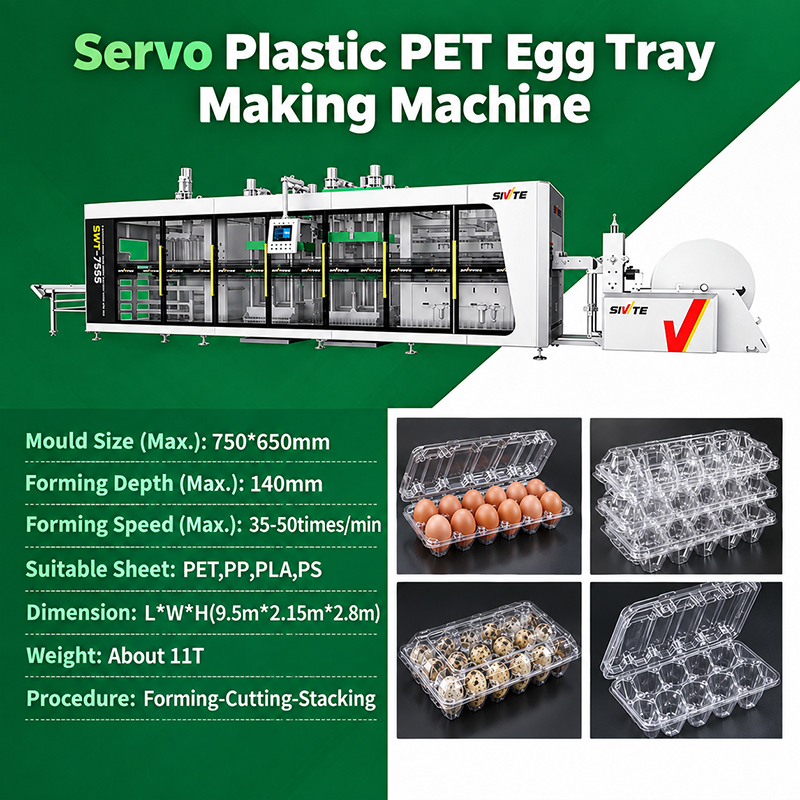
PET egg tray making machines are high-speed thermoforming lines that heat rigid PET sheet and form it into clear, protective egg clamshells. For industrial egg packaging output, the machine to buy is a multi-station positive and negative pressure thermoforming machine — not a paper pulp former.
That single distinction decides whether you produce 5,000 or 30,000 retail-ready trays per shift.
The Short Answer: Positive and Negative Pressure Thermoforming Machines
An egg tray thermoforming machine unwinds PET sheet from a roll, heats it to forming temperature, shapes the egg cups and snap-locks under combined positive and negative air pressure, then punches and stacks the finished trays in-line.
Positive and negative pressure forming is essential here. Egg clamshells require deep cups, tight corner definition and a closing snap-lock — geometry that vacuum-only forming cannot reproduce at production speed.
Why PET Egg Tray Making Machines Outperform Paper Pulp Alternatives
Plastic egg packaging wins on four commercial points:
- Shelf appeal. Optical-grade PET shows the product through a crystal-clear wall. Paper pulp cannot.
- Rigid protection. Deep cups and snap-locks keep eggs fixed during transport, cutting breakage rates.
- Hygiene. Food-contact PET sheet is smooth, non-absorbent and easy to seal — no fiber dust, no moisture uptake.
- Unit cost at volume. Full automation keeps labor at 1–2 operators per shift, and uniform wall thickness optimizes material use.
How Plastic PET Egg Trays Are Produced: The 4-Step Process
- Sheet feeding. A motorized unwinder feeds PET sheet rolls into the line at controlled tension.
- Heating. Ceramic heating zones raise the sheet to its exact thermoforming temperature, with multi-zone control that protects clarity.
- Pressure forming. Positive and negative air pressure shapes the deep egg cups, ribs and snap-lock contours.
- Cutting and stacking. Integrated punching trims every tray cleanly, then automatic stacking counts and stacks the finished product.
High-Speed Solution: The SWT-7565 Thermoforming Machine
[Image: SWT-7565 PET Egg Tray Thermoforming Machine – TZ Machinery]
For egg packaging at industrial volume, the SWT-7565 thermoforming machine delivers continuous, fully automatic output with servo-driven precision.
| Parâmetro | Especificação |
|---|---|
| Forming method | Positive & negative pressure |
| Max. forming area | 760 × 650 mm |
| Min. forming area | 460 × 350 mm |
| Max. forming depth | 120 mm |
| Velocidade de produção | Up to 45 cycles/min (product-dependent) |
| Materiais adequados | PET, PP, PS, PVC, PLA |
| Espessura da folha | 1.5–2.0 mm (product-dependent) |
| Station layout | 3 or 4 stations (forming, punching, cutting, stacking) |
| Punching clamping force | 80 toneladas |
| Heating ovens | 2 units, 1,925 mm total length |
| Potência instalada | ≈140 kW |
Why the SWT-7565 Excels for Transparent Egg Packaging
Fast Cycle Speed
At up to 45 cycles per minute, multi-cavity egg molds multiply output quickly. At 30 cycles/min with a 10-cavity mold, theoretical output reaches roughly 18,000 trays per hour — capacity that scales with cavity count rather than headcount.
Servo-Driven Accuracy
Full servo control on sheet feeding, mold clamping and plug assist holds uniform wall thickness across deep egg cups and delivers a clean, burr-free trimmed edge.
Clareza ótica
Multi-zone heating spreads temperature evenly across the sheet, preventing hazing or optical distortion in transparent PET.
PET Egg Tray Applications and Buyer Profiles
Typical products and the buyers who run them:
- Retail egg clamshells — 6-egg, 10-egg and 12-egg packs for supermarkets and egg brands
- Specialty egg trays — quail, duck and bantam egg packs
- Transport and hatching trays — rigid, stackable, ventilated configurations
- Egg-packaging converters — third-party food packaging manufacturers serving multiple egg brands
How to Choose a PET Egg Tray Making Machine
Match the machine to your mold and material before comparing prices:
- Cavity count vs. forming area. Confirm your egg mold fits the forming area — for example, 760 × 650 mm on the SWT-7565.
- Forming depth and draw ratio. Deep egg cups need a machine rated for the depth, typically 110–120 mm and above.
- Sheet thickness and material. Virgin PET, rPET, PLA and PP behave differently; confirm the machine’s rated thickness range against your sheet spec.
- Cycle time vs. target output. Work backwards from required trays per hour to cavities and cycle time.
- Cutting method. In-mold punching avoids a second operation and protects the tray rim.
- Upstream sheet supply. If you plan to extrude your own sheet, pair the former with a twin screw PET sheet extrusion machine for integrated rPET production.
Two further TZ-machinery models are worth comparing for egg packaging projects: the TZ-7385 positive and negative pressure thermoforming machine, a three/four-station line with a large forming area, and the TZ-6245 high speed multi-station thermoforming machine, which trades forming area for higher precision on smaller products.
Summary: Matching the Machine to Your Egg Tray Line
PET egg tray production comes down to three variables — forming technology, speed and mold capacity. A positive and negative pressure thermoforming machine with servo indexing and in-line cutting gives you clear, rigid, retail-ready trays at the lowest unit cost.
FAQ
Que máquina fabrica tabuleiros de plástico para ovos?
Uma máquina de termoformação de pressão positiva e negativa com várias estações. Aquece a folha de PET, molda os suportes para ovos e os fechos de encaixe sob pressão de ar e, em seguida, perfura e empilha as bandejas automaticamente.
As bandejas de ovos em PET são melhores do que as de pasta de papel?
Atendem a mercados diferentes. As bandejas de PET oferecem transparência, rigidez e resistência à humidade para exposição no retalho, enquanto as bandejas de pasta de papel são opacas e têm menor apelo visual. O PET é preferido nos casos em que a visibilidade do produto é um fator determinante para a venda.
Quantas bandejas para ovos consegue uma máquina de termoformagem produzir por hora?
Output equals cycles per minute × cavities per mold × 60. At 30 cycles/min with a 10-cavity mold, theoretical output is about 18,000 trays per hour; actual output depends on sheet material and mold design.
As máquinas de termoformação de tabuleiros para ovos podem processar PET reciclado?
Sim, desde que as especificações da máquina e da chapa sejam adequadas ao rPET. O material reciclado é totalmente compatível com a termoformação quando a chapa é devidamente cristalizada e seca antes da formação.
Qual é a espessura da chapa utilizada nas bandejas de ovos em PET?
It depends on tray size and cup depth. Confirm the thickness against the machine’s rated range before ordering the mold, since deep cups need sufficient wall thickness to hold shape.
Quantas cavidades pode ter um molde para tabuleiros de ovos?
Egg tray molds commonly carry 6, 10 or 12 cavities per cycle. The practical limit is the machine’s forming area — a larger forming area allows more cavities and higher output per stroke.
Do I need a PET sheet extrusion line as well?
Only if you want to produce sheet in-house. Buying finished PET sheet and running a thermoformer is the faster route; adding an extrusion line lowers material cost on high-volume rPET projects.
What determines the price of a PET egg tray making machine?
Forming area, station configuration, servo system, heating zones, mold design and automation level.