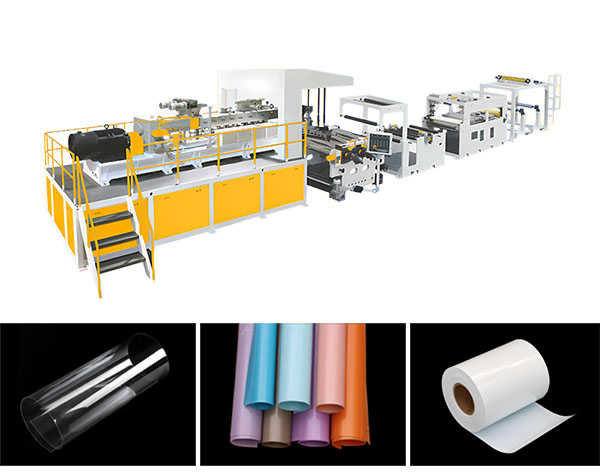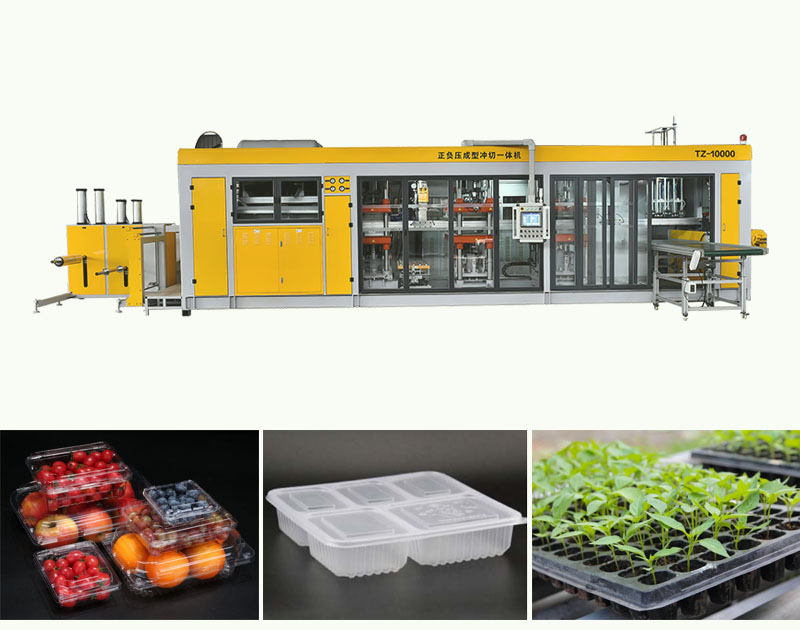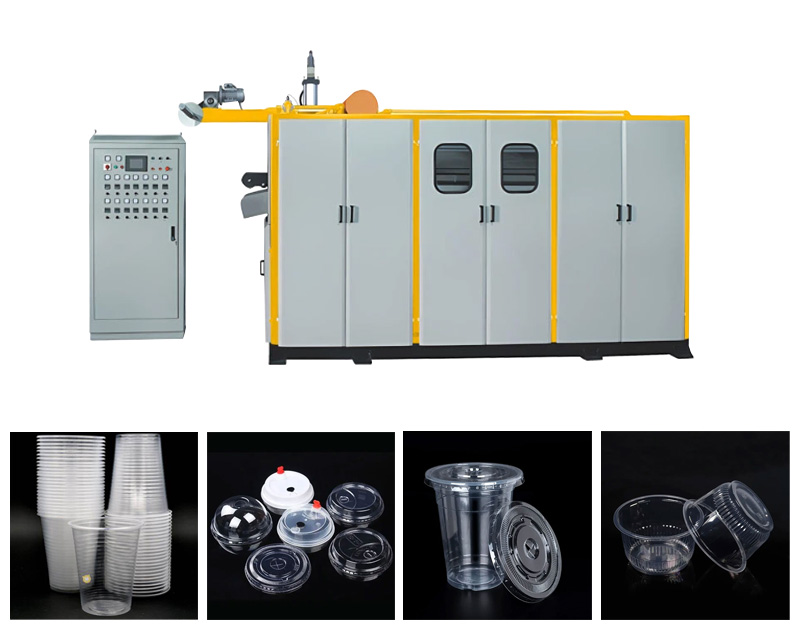
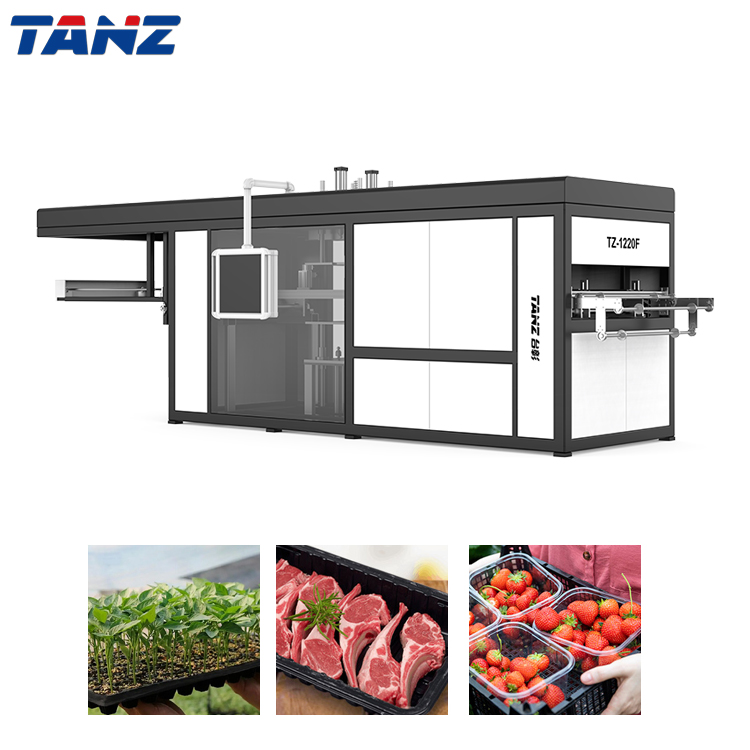
เครื่องขึ้นรูปด้วยความร้อน
เทคโนโลยีที่พิสูจน์แล้ว, โซลูชันครบวงจร, ประสบการณ์ที่อุดมสมบูรณ์, ระบบอัตโนมัติเต็มรูปแบบ, ระบบกึ่งอัตโนมัติ, ระบบสาม/สี่สถานี; ผลิตภาชนะบรรจุอาหาร, กล่องบรรจุผลไม้, ถาดไข่, ถาดเพาะชำ, ถาดอิเล็กทรอนิกส์, ถาดอาหาร, กล่องหอย, เป็นต้น.

SWT-7565 Three/four Station Thermoforming Machines For Food Packaging
A thermoforming machine for food packaging is an automated production line that heats thermoplastic sheets and forms them into finished containers — lunch boxes, cups, trays, lids, and clamshells
1, ระยะเวลาการผลิต: 1-2 เดือนหลังจากยืนยันการชำระเงินมัดจำ
2, เงื่อนไขราคา: FOB, EXW, CFN, CIF, เป็นต้น.
3,การชำระเงิน: T/T,Visa,Paypal,ฯลฯ.
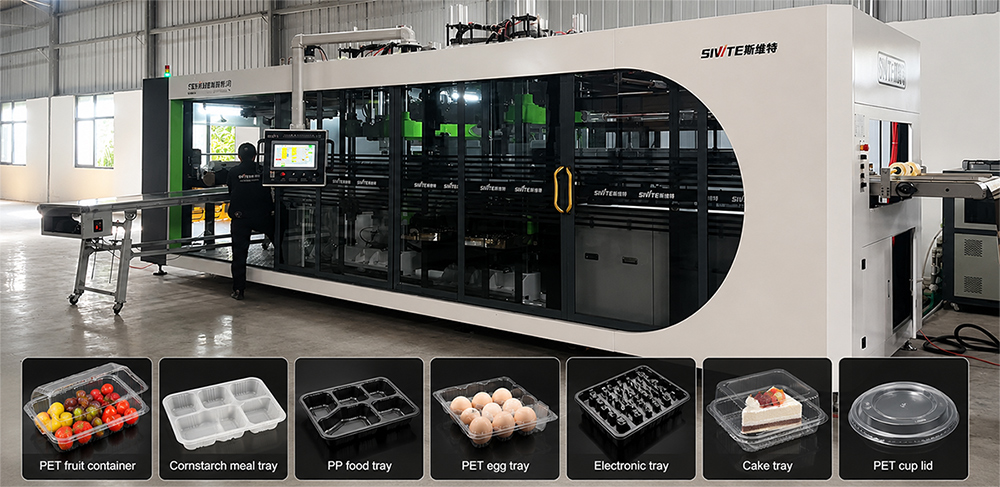
A thermoforming machine for food packaging is an automated production line that heats thermoplastic sheets and forms them into finished containers — lunch boxes, cups, trays, lids, and clamshells — through a continuous process of unwinding, heating, forming, punching, and stacking. The SWT-7565 is a three-station positive/negative pressure automatic thermoforming machine designed for high-output food packaging manufacturers who need reliable, servo-driven precision with CE-certified compliance.
What Is a Three-Station Thermoforming Machine for Food Packaging?
A three-station thermoforming machine organizes the entire container-making process into three sequential workstations — forming, punching, and stacking — within a single continuous line. Raw plastic sheet unwinds from a roll, passes through dual heating ovens, reaches the forming station where it is shaped under positive and negative pressure, moves to the punching station for precise trimming, and finally arrives at the stacking station where finished containers are counted and stacked automatically. This integrated design eliminates manual sheet transfer between separate machines, reducing labor to just 1–2 operators per shift.
The SWT-7565 can also be configured as a four-station model (adding an inline hole-punching station after punching) for lid and container products that require ventilation or drainage holes — common in fresh produce and prepared meal packaging.
SWT-7565 Technical Specifications
| พารามิเตอร์ | ข้อกำหนด |
|---|---|
| Max. Forming Area | 760 × 650 mm |
| Min. Forming Area | 460 × 350 mm |
| ความลึกสูงสุดของการขึ้นรูป | 120 mm |
| Production Speed | 5–45 cycles/min (product-dependent) |
| วัสดุที่เหมาะสม | PP, PS, PET, PVC, PLA |
| Sheet Width Range | 480–780 mm |
| ความหนาของแผ่น | 1.5–2.0 mm (product-dependent) |
| Forming Mold Closing Height | 400–500 mm |
| Punching Mold Closing Height | 280–380 mm |
| Punching Clamping Force | 80 Tons |
| Heating Ovens | 2 units, total length 1,925 mm |
| Max. Unwinding Roll Diameter | 1,200 mm |
| กำลังไฟฟ้าติดตั้ง | ≈140 kW (actual consumption 60–70%) |
| Machine Dimensions (L×W×H) | 13,000 × 2,800 × 2,900 mm |
| Power Supply Requirement | 3-phase, 380V, 50 Hz; customization |
Key Engineering Features That Define the SWT-7565
One-Piece Cast Mold Tables with Crankshaft + 5-Point Clamping
Unlike welded mold table assemblies common in budget thermoforming machines, the SWT-7565 uses one-piece cast iron mold tables driven by a crankshaft and 5-point clamping structure. This design distributes the 80-ton punching force evenly across the mold surface, eliminates weld-fatigue failure points, and maintains consistent clamping parallelism over years of high-cycle operation. For food packaging manufacturers running 24-hour shifts, this directly translates to longer mold life and fewer unplanned stoppages.
Full Delta Servo Drive System
All four motion axes — mold table clamping, forming stretch assist, sheet feeding, and finished-product stacking — are driven by Delta servo motors with closed-loop position control. Servo-driven sheet indexing achieves precise material registration, reducing trim waste and ensuring consistent wall thickness distribution in every formed container. Compared to hydraulic or pneumatic-only systems, servo drives cut energy consumption (actual operating power is 60–70% of the 140 kW installed rating) and allow rapid mold changeover through programmable position presets.
Independent-Heating-Brick Temperature Control
The dual heating ovens are zoned with 120×120 mm ceramic heating bricks, each independently regulated by a Yamatake temperature controller. This per-brick PID control means the operator can fine-tune heat distribution across the sheet width — critical when running thinner material near the oven edges or when switching between PP, PET, and PLA, which each have distinct optimal forming temperature windows. The result: fewer cold spots, reduced scrap rate, and lower energy waste from over-heating unused zones.
CKD Positive + Negative Pressure Forming (Japan)
Equipped with Japanese CKD pneumatic solenoid valves, the forming station applies both positive pressure (from above) and vacuum (from below) simultaneously. This dual-pressure forming method produces sharper corner definition and more uniform wall thickness than vacuum-only systems — especially important for deep-draw food containers up to 120 mm depth. The valve response time, measured in milliseconds, ensures consistent part quality even at the machine’s maximum speed of 45 cycles per minute.
1000-Group Recipe Memory with Schneider Controls (France)
The HMI operating system stores up to 1,000 product recipes, each containing complete parameters: heating zone temperatures, mold closing heights, servo stroke positions, cycle speed, and stacking counts. Schneider inverters, contactors, and circuit breakers form the electrical backbone. Switching from a round 500 ml lunch box to a rectangular 1,000 ml meal tray takes minutes instead of hours — recalling the stored recipe automatically repositions all servo axes and temperature setpoints.
Food Packaging Applications: What the SWT-7565 Produces
| หมวดหมู่สินค้า | Examples | Common Material |
|---|---|---|
| Takeaway Containers | Lunch boxes, compartment trays, clamshells | PP, PET |
| Dairy & Dessert Cups | Yogurt cups, pudding cups, ice cream tubs | PP, PS |
| Fresh Produce Packaging | Fruit trays, berry punnets, salad bowls with lids | PET, PLA |
| Ready-Meal Trays | Microwaveable meal trays, dual-compartment trays | CPET, PP |
| Disposable Tableware | Plates, bowls, lids, sauce cups | PP, PS, PLA |
Energy Consumption & Utility Requirements
| Utility | Requirement |
|---|---|
| Electricity | ≈140 kW installed; actual draw 84–98 kW (60–70%) |
| Cooling Water | ≤0.5 m³; must be free of phosphorus, sulfur, and iron |
| Compressed Air | ≈1,200 L/min at 0.6–0.8 MPa |
| ระบบระบายความร้อน | Panasonic refrigeration compressor (10 HP) |
| Operators Required | 1–2 per shift |
How to Choose a Thermoforming Machine for Food Packaging: 6 Decision Factors?
1. Match Forming Area to Your Largest Product
The SWT-7565’s maximum forming area of 760×650 mm comfortably accommodates multi-cavity molds for small containers or single-cavity molds for large trays. If your product portfolio includes jumbo catering trays exceeding 700 mm in width, verify cavity layout fits within this envelope. For smaller products like sauce cups (50–100 mm diameter), a single mold can hold 12–20 cavities, multiplying effective output.
2. Check Material Compatibility
The machine handles PP, PS, PET, PVC, and PLA across a thickness range of 1.5–2.0 mm. If you plan to run bio-based PLA — increasingly demanded in European food packaging markets — confirm that the independent heating zone control can maintain PLA’s narrow forming window (typically 80–110°C sheet surface temperature). The Yamatake per-brick controllers are well-suited for this precision requirement.
3. Evaluate Production Speed vs. Mold Changeover Frequency
At 5–45 cycles per minute, the SWT-7565 suits both medium-volume specialty packaging (lower speeds, frequent changeovers) and high-volume commodity container production (maximum speed, long runs). The 1,000-recipe memory and servo-driven mold positioning make frequent changeovers economically feasible — a key consideration if you supply multiple food brands with different container specifications.
4. Verify Utility Infrastructure at Your Facility
The machine requires 3-phase 380V/50Hz power, compressed air at 1,200 L/min, and clean cooling water. Before ordering, confirm your facility can deliver these utilities at the specified connection points. For regions with 60 Hz power (e.g., North America, parts of South America, Philippines), discuss transformer and inverter configuration with the manufacturer.
5. Consider Three-Station vs. Four-Station Configuration
The standard three-station layout (forming → punching → stacking) covers most food packaging applications. Upgrade to four stations (adding inline hole punching) if your product mix includes vented lids, berry punnets requiring drainage, or containers needing hang-holes for retail display. The incremental cost and machine length increase are modest relative to the downstream labor savings of eliminating a separate hole-punching operation.
What is the maximum output per hour of the SWT-7565 thermoforming machine?
At 45 cycles per minute, the SWT-7565 produces up to 2,700 formed sheets per hour. Actual container output depends on cavity count per mold. A 12-cavity lunch box mold running at 40 cycles/min yields 28,800 containers per hour. A 4-cavity deep-draw tray mold at 25 cycles/min produces 6,000 trays per hour.
Can the SWT-7565 run biodegradable PLA material?
Yes. The machine is compatible with PLA sheet in the 1.5–2.0 mm thickness range. The Yamatake per-brick temperature controllers allow operators to dial in PLA’s specific forming window, and the Panasonic refrigeration compressor maintains consistent mold cooling — both critical for PLA’s heat-sensitive behavior during thermoforming.
How long does mold changeover take on this machine?
With the slide-rail mold mounting system, automatic clamping, and servo-driven recipe recall, a complete mold changeover (forming + punching stations) typically takes 15–30 minutes. This compares to 60–90 minutes on machines without stored recipes and manual clamping.
What is the difference between positive/negative pressure forming and vacuum-only forming?
Vacuum-only forming draws the heated sheet against the mold using atmospheric pressure (approximately 1 bar differential). Positive/negative pressure forming adds compressed air from above (typically 5–6 bar), creating a much higher forming force. This produces sharper details, more uniform wall thickness, and better replication of mold surface texture — essential for food packaging where container appearance and dimensional consistency matter.
What CE certifications does the SWT-7565 carry?
The SWT-7565 is manufactured under ISO9001 quality management and carries CE certification, confirming compliance with European health, safety, and environmental standards. This is mandatory for food packaging machinery imported into the European Union and is increasingly required by buyers in other regulated markets.
How much factory floor space does the SWT-7565 require?
The machine footprint is 13,000 mm (length) × 2,800 mm (width) × 2,900 mm (height). Plan for additional clearance of at least 2 meters on all sides for operator access, material loading, mold change, and maintenance. The unwinding station requires front access for roll changes, and the stacking station at the rear needs space for finished-product collection bins or conveyor integration.
What sheet materials produce the best results for food packaging?
PP (polypropylene) is the workhorse material for hot-fill and microwaveable food containers due to its heat resistance. PET offers superior clarity for visible-product packaging like salad and fruit trays. PS provides rigidity for disposable cups and lids. PLA is the choice for compostable packaging applications, particularly in European markets.
Is on-site installation support available internationally?
Yes. The manufacturer dispatches 1–2 technicians to the customer’s facility for installation, commissioning, and operator training. The customer prepares the foundation, utility connections (power, water, compressed air), and raw materials per the installation drawing. Service costs depend on the destination country and duration of commissioning.
ผลิตภัณฑ์ที่เกี่ยวข้อง:

หมวดหมู่:
การสอบถามเพื่อหาทางแก้ไข:
ไจจาง แมชชีนเนอรี่ โซลูชั่นส์