
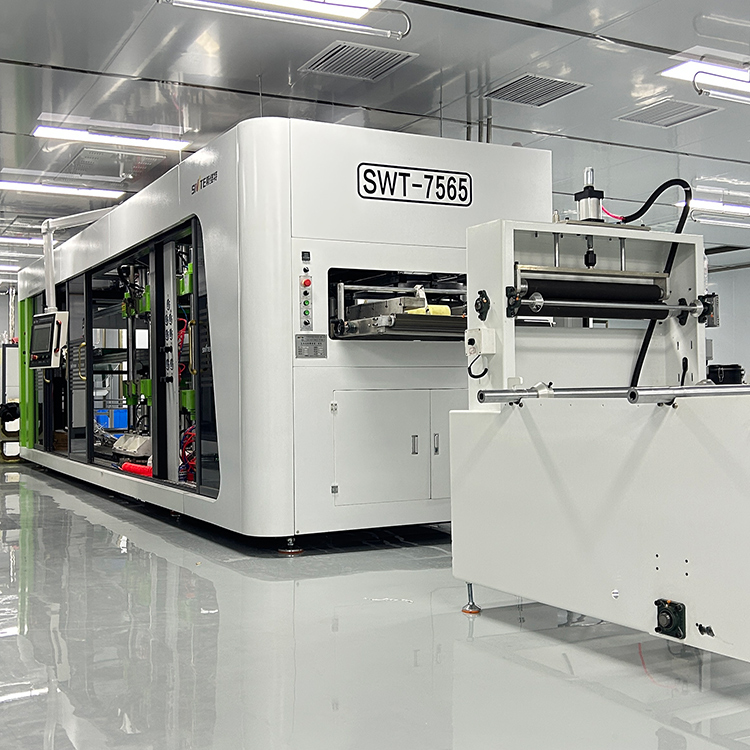
When a food packaging buyer in Nigeria, Kenya, Ethiopia, South Africa, Egypt, Ghana, Tanzania, Côte d’Ivoire, Uganda, Rwanda, Zambia, Morocco, Tunisia, Algeria, Senegal, Cameroon, DR Congo, Angola, Mozambique, Zimbabwe, Botswana, Namibia, Sudan, Mauritius, Madagascar, Malawi, Burkina Faso, Mali, Niger, Chad, Benin, Togo, Sierra Leone, Liberia, Guinea, Gabon, Congo, Burundi, Djibouti, Somalia, Eritrea, Libya, or Mauritania searches for the best thermoforming machine for food packaging in Africa, the answer is a fully automatic three-station thermoforming system engineered for the continent’s diverse operating environment — and critically, the power supply voltage can be factory-configured to match each country’s actual industrial grid standard, whether that is Nigeria’s 415V, South Africa’s 400V or 525V, Kenya’s 415V, Egypt’s 380V, or any other national specification. This is not a one-voltage machine; it is built to order for your country’s real-world electrical infrastructure.
Why African Food Packaging Manufacturers Are Investing in Thermoforming Equipment
Africa’s food packaging industry is expanding at approximately 3.85% CAGR through 2034, driven by population growth, urbanization, and expanding retail and quick-service restaurant sectors across the continent. The packaging market reached an estimated USD 45.07 billion in 2025 (Source: Mordor Intelligence, 2026) — with thermoformed plastic containers among the fastest-growing sub-segments.
Four structural factors are accelerating local thermoforming investment:
- Import substitution: Governments across Nigeria, Kenya, and Ethiopia have implemented policies favoring locally manufactured packaging. Factory-gate prices for thermoformed containers produced locally undercut imported equivalents by 25–40% after clearing customs and freight.
- Quick-service restaurant growth: KFC, McDonald’s, and hundreds of regional chains are expanding across sub-Saharan Africa, creating predictable, high-volume demand for disposable food containers.
- Supermarket formalization: The shift from open-air markets to formal retail in South Africa, Nigeria, and Kenya is driving demand for sealed, labeled, thermoformed trays for meat, produce, and prepared meals.
- Plastic sheet availability: PP and PS sheet manufacturers operate in South Africa, Egypt, and Nigeria, reducing raw material lead times for local thermoformers.
What Makes a Thermoforming Machine Suitable for Africa?
Not every thermoforming machine sold globally is appropriate for African operating conditions. The following five specifications are non-negotiable for buyers sourcing equipment for African facilities:
1. Voltage Customization for Your Country’s Grid
This is the single most overlooked specification. Africa is not a single power grid — Nigeria’s industrial standard is 415V/50Hz 3-phase, South Africa uses 400V or 525V depending on the facility, Kenya and Uganda operate at 415V, Egypt and Ethiopia use 380V, Ghana and Côte d’Ivoire are at 400V. A machine hard-wired to one voltage will not run correctly on another — and a frequency converter adds cost and failure risk. The correct approach is a manufacturer who configures the main transformer, servo drives, and control cabinet to your specific country’s industrial voltage before shipment. Confirm your factory’s exact supply voltage and request written confirmation of factory-configured voltage matching in your purchase agreement.
2. Voltage Tolerance and Surge Protection
Power fluctuations and voltage dips are common across many African industrial zones. Servo-driven machines with modern PLC controllers tolerate ±10% voltage variation, and built-in surge protection on the electrical cabinet is essential for protecting control electronics during load shedding or grid switching events.
3. On-Site Installation and Training
A thermoforming machine is a complex electromechanical system requiring commissioning by a qualified technician. Buyers should only purchase from manufacturers who dispatch factory technicians to the customer’s facility for installation, mold setup, trial production, and operator training — and who provide a clear timeline for doing so.
4. Material Flexibility (PP / PET / PS / PLA)
African food packaging buyers serve diverse end markets — disposable dining, supermarket trays, export produce packaging, and increasingly compostable foodservice packaging. A machine capable of running PP, PET, PS, and PLA without mechanical modification gives buyers the flexibility to respond to market shifts without capital reinvestment.
5. Spare Parts Lead Time
Downtime is disproportionately costly in markets where technical service infrastructure is thin. Choose a manufacturer who maintains an inventory of fast-wear parts (forming chains, heating elements, punching blades) and can ship DHL express to major African hubs within 3–5 business days.
SWT-7565: Purpose-Built for African Food Packaging Production
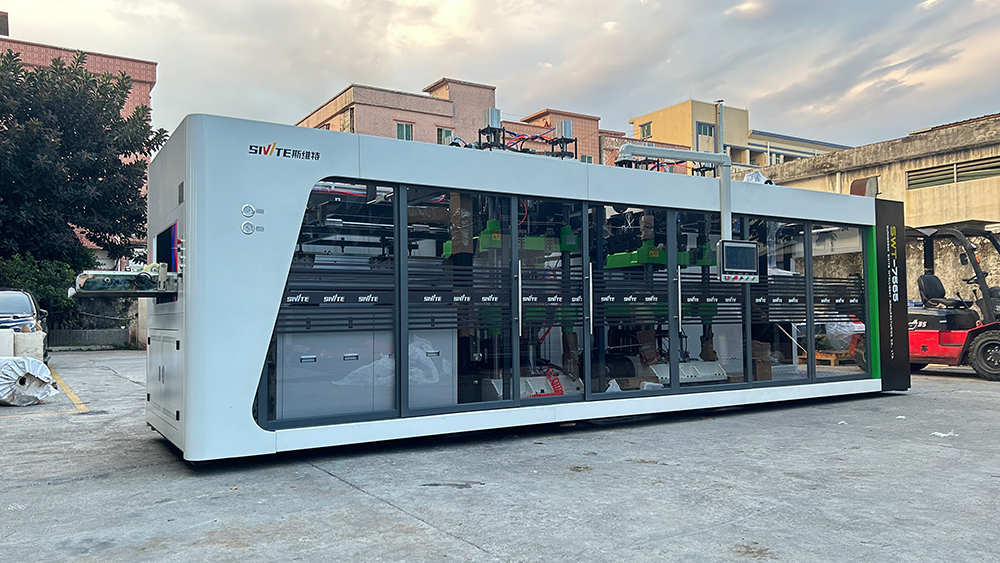
The SWT-7565 is a three-station fully automatic positive/negative pressure thermoforming machine designed for continuous high-output food packaging production. Its key advantage for African buyers: the power supply is factory-configured to your country’s voltage — whether 380V, 400V, 415V, or 525V at 50Hz — eliminating the need for external transformers or frequency converters.
| พารามิเตอร์ | ข้อกำหนด |
|---|---|
| Max. Forming Area | 760 × 650 mm |
| Production Speed | 5–45 cycles/min |
| Compatible Materials | PP, PS, PET, PVC, PLA |
| ความหนาของแผ่น | 1.5–2.0 mm |
| Machine Footprint (L×W×H) | 13,000 × 2,800 × 2,900 mm |
| แหล่งจ่ายไฟ | Custom-configured to your country’s industrial voltage (380V/400V/415V/525V, 50Hz) |
| ระบบขับเคลื่อน | Delta servo (chain transport + forming + punching) |
| Certifications | ISO 9001, CE |
Country-Specific Voltage Requirements and Market Context
Every African country has a distinct industrial power standard. Below is the real-world voltage specification buyers should confirm with their manufacturer before ordering.
| ประเทศ | Typical Industrial Voltage | Key Market Drivers |
|---|---|---|
| Nigeria | 415V / 50Hz | Largest consumer market; lunch box and cup production for fast food chains |
| Kenya | 415V / 50Hz | Export horticulture trays; supermarket chain packaging |
| Ethiopia | 380V / 50Hz | Industrial park incentives; duty exemptions on capital equipment |
| South Africa | 400V or 525V / 50Hz | Most sophisticated retail infrastructure; premium tray and clamshell demand |
| อียิปต์ | 380V / 50Hz | Largest North African manufacturing hub; domestic + Gulf export |
| Ghana | 400V / 50Hz | Urbanization-driven food packaging demand; Accra/Tema industrial zone |
| Tanzania | 415V / 50Hz | Dar es Salaam port access; growing food processing sector |
| Côte d’Ivoire | 400V / 50Hz | Francophone West Africa hub; Abidjan industrial base |
| Uganda | 415V / 50Hz | East African Community trade access; growing domestic food processing |
| Morocco | 380V / 50Hz | Proximity to European export markets; advanced industrial infrastructure |
| Senegal, Cameroon, Zambia, Rwanda | 400V / 50Hz | Emerging food packaging markets; urban retail growth driving demand |
Food Packaging Applications by Country
| หมวดหมู่สินค้า | Recommended Material | Key Markets |
|---|---|---|
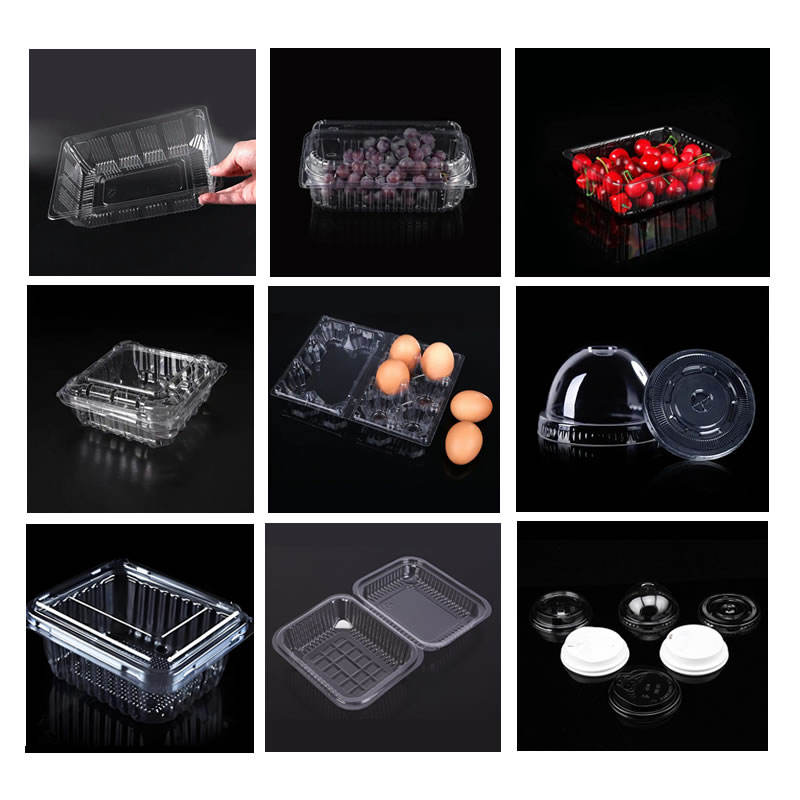
| Lunch boxes / meal containers | พีพี | Nigeria, Kenya, Ethiopia, Ghana, Tanzania |
| Disposable cups | PS, PP | All markets |
| Supermarket meat / produce trays | PET, PP | South Africa, Kenya, Egypt, Morocco |
| Export fresh produce packaging | PET, PLA | Kenya, Ethiopia, Côte d’Ivoire, Senegal |
| ภาชนะแบบฝาพับ | PET, PP | South Africa, Nigeria, Egypt |
| Compostable food containers | PLA | South Africa, Kenya (premium retail) |
How to Choose a Thermoforming Machine as an African Buyer
Step 1 — Confirm Your Country’s Actual Voltage
This is step one — before discussing mold size, output speed, or price. Measure your factory’s actual supply voltage at the main distribution panel. Do not rely on “national standard” assumptions. Your factory may receive 400V while the country nominal is 415V, or vice versa. Provide the measured voltage and phase configuration to the manufacturer and require written confirmation of factory-configured voltage matching.
Step 2 — Define Your Primary Product and Output Target
Start with the specific container — lunch box, cup, tray — and the monthly volume target. Confirm your mold design against the machine’s forming area before purchasing.
Step 3 — Verify Utilities Availability
Beyond power, confirm your compressed air capacity and cooling water supply. Undersized utilities are the most common reason for thermoforming machines running below rated speed.
Step 4 — Calculate Total Landed Cost
FOB machine price, ocean freight to your port, import duty, VAT, inland transport — budget for a 15–25% premium over FOB price for total landed cost. Indicative import duty rates: Nigeria 5–10%, Kenya 0% (EAC CET), Ethiopia 0–5%, South Africa 0%, Egypt 5–15% — confirm with a licensed customs broker in your country.
Step 5 — Confirm After-Sales Support
Request written confirmation of: technician dispatch for installation, remote support response time, spare parts inventory and express shipping capability, and warranty terms.
Three-Station vs. Single-Station: Which Is Right for Your Market?
| ปัจจัย | Three-Station Automatic | Single-Station Semi-Auto |
|---|---|---|
| Output speed | 5–45 cycles/min | 3–12 cycles/min |
| Labor requirement | 1–2 operators/shift | 3–5 operators/shift |
| Capital cost | Higher | Lower |
| Container consistency | Very high | Moderate |
| Best market fit | Nigeria, South Africa, Egypt, Kenya, Morocco | Startups in Ethiopia, Tanzania, Ghana, Uganda |
| Payback period | 18–36 months | 12–24 months |
คำถามที่พบบ่อย
What is the best thermoforming machine for Nigeria?
For Nigerian food packaging manufacturers targeting lunch boxes, cups, and food trays at commercial output volumes, a fully automatic three-station thermoforming machine with factory-configured 415V/50Hz power supply — not a generic 380V machine — is the correct choice. Buyers in Lagos, Kano, and Port Harcourt should factor 15–20% on top of FOB price for total landed cost including import duty and inland freight. Confirm your factory’s measured voltage before ordering.
What is the best thermoforming machine for Kenya?
Kenyan factories — particularly those supplying supermarket chains or producing horticultural export trays — require a thermoforming machine configured for Kenya’s 415V/50Hz industrial supply, compatible with PET and PP, and capable of consistent forming quality for sealed trays. Kenya’s EAC CET framework typically sets 0% import duty on industrial machinery.
Can the voltage be customized for my country’s grid?
Yes — this is the critical distinction between a generic machine and one purpose-built for Africa. The SWT-7565’s main transformer, servo drives, and control cabinet are factory-configured to your country’s actual industrial voltage — 380V (Ethiopia, Egypt, Morocco), 400V (South Africa, Ghana, Côte d’Ivoire, Senegal, Zambia), 415V (Nigeria, Kenya, Uganda, Tanzania, Sudan), or 525V (certain South African facilities). You provide your factory’s measured voltage; the manufacturer configures the machine before shipment. No external transformer or frequency converter needed.
How long does it take to import a thermoforming machine from China to Africa?
Ocean freight takes approximately 20–30 days to East Africa (Mombasa, Dar es Salaam), 25–35 days to West Africa (Lagos, Tema, Abidjan), 20–28 days to North Africa (Alexandria, Port Said), and 25–35 days to South Africa (Durban). Add 10–30 days for port clearance. Total delivery from order to factory: 90–120 days is a realistic planning figure.
What import duty applies to thermoforming machines in Africa?
Import duty rates vary by country: Nigeria 5–10% + 7.5% VAT; Kenya 0% (EAC CET) + 16% VAT; Ethiopia 0–5% (industrial park tenants may qualify for exemption) + 15% VAT; South Africa 0% + 15% VAT; Egypt 5–15% + 14% VAT; Ghana 0–5% + 12.5% VAT. Confirm current rates with a licensed customs broker in the destination country.
What products can African factories produce with this machine?
With the correct mold (ordered separately per container design), the SWT-7565 produces PP lunch boxes, PS disposable cups, PET supermarket trays, PET clamshells for fresh produce, and PLA compostable containers. Output depends on cavity count: a 12-cavity lunch box mold at 40 cycles/min yields 28,800 containers per hour.
Is on-site installation available in all African countries?
Yes. TZ Machinery dispatches qualified technicians to any African country for installation, commissioning, mold setup, trial production, and operator training. The customer prepares the factory foundation, utility connections — including the confirmed voltage at the main panel — and raw materials for trial runs. Installation typically takes 5–10 working days.
Does the machine work in countries with unstable power supply?
Voltage tolerance is ±10% on servo-driven machines with modern PLC controllers. For factories in areas with severe instability (frequent brownouts, phase loss), adding a voltage stabilizer or UPS for the control system is recommended. These can be sourced locally or included in the machine order. The key is starting with a machine configured to your country’s nominal voltage — not compensating for a mis-spec with add-on equipment.
สรุปประวัติการทำงานอย่างมืออาชีพ
For food packaging manufacturers across Africa — from Nigeria to Kenya, Ethiopia to South Africa, Egypt to Ghana, Tanzania to Côte d’Ivoire, Uganda to Morocco, Senegal to Zambia — the single most critical specification when buying a thermoforming machine is not forming area, cycle speed, or material compatibility. It is voltage configuration. Africa has at least four industrial voltage standards (380V, 400V, 415V, 525V), and a machine hard-wired to the wrong voltage will fail to operate correctly. The SWT-7565 solves this by factory-configuring the entire electrical system — transformer, servo drives, PLC, and control cabinet — to your country’s actual measured supply voltage before shipment. Contact TZ Machinery with your factory’s voltage reading and target product for a configured quotation and delivery timeline.