
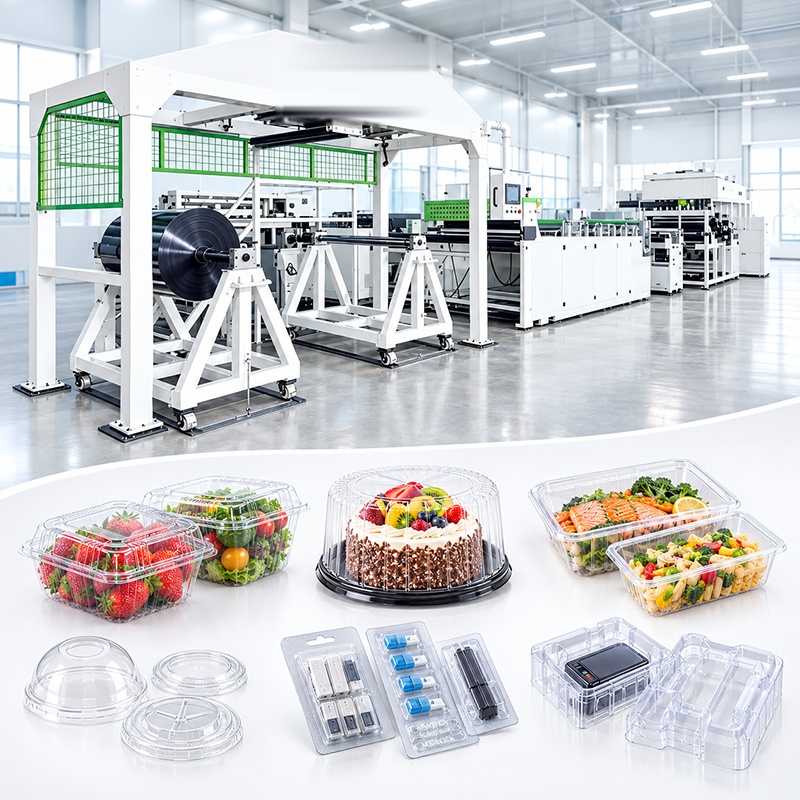
The modern thermoforming and packaging industry demands high clarity, rigid strength, and lower production costs. Reaching all three on a single-layer extruder usually means paying for 100% virgin PET resin. The TZ-machinery ABA PET three-layer co-extrusion sheet line solves this: an ABA structural sandwich lets manufacturers maximize recycled content without giving up surface finish or food-grade compliance.
1. What Is an ABA Co-Extrusion Structure?
In an ABA three-layer co-extrusion system, two extruders split the sheet into three distinct layers:
- Layer A (outer surfaces): thin, high-clarity skins made of virgin PET or functional additives.
- Layer B (core): a thick inner core – up to 70%-80% of total sheet thickness – that runs recycled PET (rPET), bottle flake, or industrial regrind.
Lower-cost or recycled polymer is encapsulated between two virgin outer shells, so the sheet keeps a pristine visual appearance and smooth sealing behaviour while resin overhead drops sharply. If your feedstock is mostly recycled flake, see which PET extrusion machine suits recycled PET for the wider selection logic.
2. Key Advantages of the TZ-machinery ABA PET Line
Significant raw material cost savings
Feeding rPET flake or factory scrap into the primary B-layer extruder cuts raw material cost substantially. The thin A-layers shield the core, hiding the colour variation and minor imperfections inherent to recycled plastic. Resin is the largest variable cost in sheet production, so this is where the payback comes from – the full model is set out in our PET sheet extrusion line investment and ROI guide.
Superior tensile strength and structural rigidity
Co-extruded sheet carries higher impact strength and tear resistance than single-layer sheet. Bonding three layers under controlled thermal conditions gives high mechanical stability, which matters for heavy-duty thermoforming and deep-draw trays.
Food-contact compliance and high visual clarity
For food packaging, fruit trays, and blister packs, safety and appearance are both non-negotiable. The virgin PET outer layers act as a clean barrier, keeping the sheet food-safe while preserving the crystal-clear transparency buyers expect from APET and PETG.
Precision temperature and melt control
Advanced melt pump metering, automatic die heads, and multi-zone temperature control hold gauge uniform across the full sheet width. Consistent gauge control minimizes thermoforming reject rates downstream.
3. Key Technical Specifications
| Caraterística | Especificação |
|---|---|
| Processed materials | APET, PETG, rPET (recycled PET flake) |
| Estrutura em camadas | ABA (surface / recycled core / surface) |
| Extruder configuration | Main extruder (core B) + side extruder (layers A) |
| Output range | 300 kg/h to 1,000+ kg/h (model dependent) |
| Espessura da folha | 0.15 mm – 1.8 mm |
| Aplicações | Thermoformed clamshells, food trays, blister packaging, folded boxes |
4. Main Applications
- Food packaging: clear hinged containers, cold drink lids, bakery trays, and produce punnets.
- Industrial and medical packaging: heavy-duty tool blisters, electronic component trays, and protective clamshells.
- Printing and folding box grade: high-clarity PET sheet for folding cartons and transparent stationery products.
5. Frequently Asked Questions
How much recycled PET can an ABA line run?
The B-layer core can reach 70%-80% of total sheet thickness, so most of the sheet volume can be rPET flake, bottle flake, or in-house regrind while the virgin A-skins stay thin.
Does a high rPET core still meet food-contact rules?
Yes. Food contact is governed by the surface, not the core. The virgin PET A-layers form the contact barrier, so the sheet stays food-safe even with a high recycled fraction inside.
What thickness and output does the line cover?
0.15 mm to 1.8 mm sheet at 300 kg/h to 1,000+ kg/h, depending on model and screw configuration.
Is an ABA line better than a single-layer line?
On cost, yes: resin is the largest variable cost, and an ABA line replaces most of it with recycled feedstock. On performance, co-extruded sheet also outperforms single-layer sheet on impact strength and tear resistance.
Which materials can it process?
APET, PETG, and rPET flake. The A-layer extruder can also carry functional additives such as colour masterbatch or anti-block.
Upgrade Your Extrusion Capabilities
An ABA PET co-extrusion sheet line gives high-volume producers a direct cost edge: lower resin cost per kilogram without losing clarity or structural integrity, which shortens the payback period. Review the Linha de coextrusão de chapas de três camadas ABA PET specifications, or compare a running configuration in our 800 kg/h ABA three-layer PET sheet line case. Send your target output, sheet width, and recycled content ratio for a tailored line configuration and quotation.