
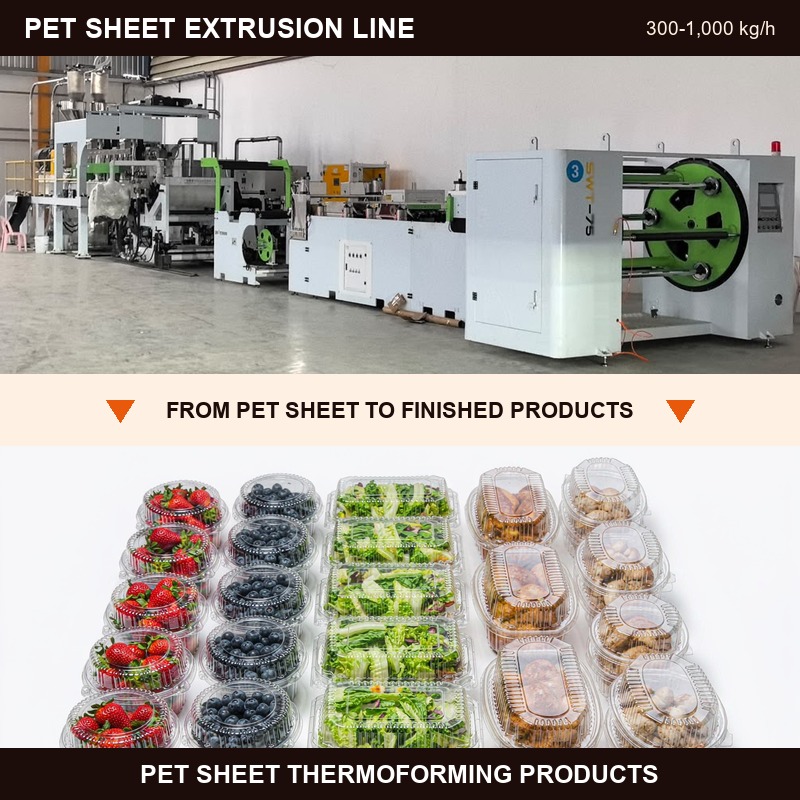
A PET sheet extrusion machine supplier for Colombia, Chile and Peru provides more than an extruder: the scope covers a complete APET/rPET sheet line — extruder, screen changer, melt pump, sheet die, three-roll calender and winder — configured for Andean voltage standards and Pacific port logistics.
Lines in this class run 300–1,000 kg/h and can carry up to 80% recycled PET bottle flake in an ABA three-layer core, keeping a virgin PET surface for food contact.
What to Check Before Sourcing to the Andes
Voltage and frequency. Chile and Peru commonly run 220/380V 60Hz; Colombian plants often use 440V 60Hz. Confirm the supply before comparing quotations.
Recycled content capability. ABA three-layer co-extrusion places 60–80% rPET flake in the core. Ask for the maximum ratio in writing, with gauge tolerance specified.
Scope of supply. Extruder, calender, winder and inline trim recycling should be specified as a matched set, so commissioning and spare parts stay with one source.
Logistics and documents. Cartagena and Barranquilla, Valparaíso and San Antonio, and Callao handle most machinery imports. Export packing, CE documentation and Spanish-language HMI are worth confirming early.
Основные технические характеристики
| Артикул | Технические характеристики |
|---|---|
| Выход | 300–1,000 kg/h |
| Толщина листа | 0.15–1.8 mm |
| Ширина листа | Up to 1,200 mm |
| Материалы | APET, PETG, rPET flake |
| Структура | Single layer or ABA three-layer |
| Controls | PLC + melt pump metering |
| Электропитание | 220/380/440V, 60Hz |
Video: An ABA three-layer PET sheet co-extrusion line running virgin PET skins over a recycled PET core.
Applications Across the Region
Chilean packers run avocado and fruit punnets, Colombian converters run bakery trays and salad clamshells, and Peruvian processors run fish and poultry trays. The same line also covers folded boxes, blister packs and cup lids. See the rPET fruit tray line for South America for a downstream example.
How to Compare Suppliers
1. Match output to thermoformer capacity — 500 kg/h feeds roughly two mid-size forming lines; 1,000 kg/h suits captive sheet supply.
2. Confirm voltage, frequency and certification for the destination country.
3. Compare commissioning, training and spare-part terms, not only the machine price. The PET sheet line cost breakdown covers the full picture.
Резюме
Selecting a PET sheet extrusion machine supplier for Colombia, Chile and Peru comes down to four checks: local power configuration, verified rPET ratio, matched line scope, and port-ready documentation.
ЧАСТО ЗАДАВАЕМЫЕ ВОПРОСЫ
Q: Do PET sheet lines ship to Colombia, Chile and Peru?
A: Yes. Machinery typically lands at Cartagena or Barranquilla, Valparaíso or San Antonio, and Callao, with export packing and full customs documentation.
Q: Can a sheet line run recycled PET?
A: Yes. ABA three-layer configuration runs 60–80% rPET flake in the core under virgin PET skins, keeping food-contact compliance.
Q: What voltage do South American lines use?
A: Common configurations are 220/380V 60Hz for Chile and Peru and 440V 60Hz for Colombia. Most suppliers build to the plant supply.
Q: How long do delivery and commissioning take?
A: Production is typically 45–60 days, followed by installation, start-up and operator training, usually completed within two weeks.
Q: What output should I choose?
A: Match output to downstream capacity. A 500 kg/h line feeds roughly two mid-size thermoforming lines; 1,000 kg/h suits captive sheet supply. The twin-screw PET sheet extrusion machine is one common starting point.