
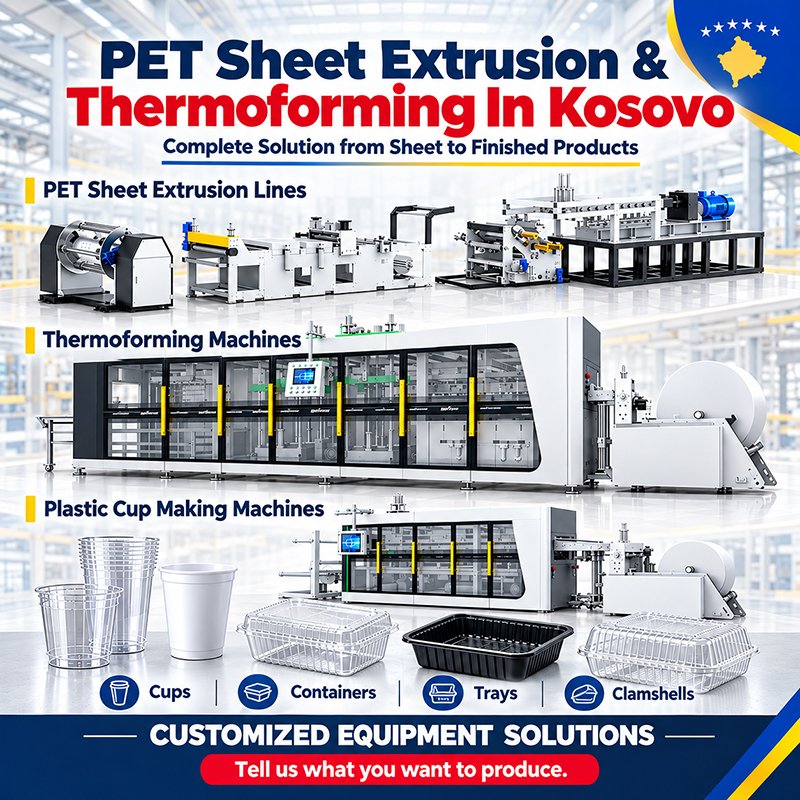
Project Background
In 2025, a leading recycling factory in Kosovo reached out to us to upgrade their rPET (recycled polyethylene terephthalate) value chain. Specializing in collecting and processing post-consumer PET bottles into high-purity rPET flakes, the client sought an integrated manufacturing solution to convert these recycled flakes into food-grade PET packaging, such as fresh fruit boxes, clamshells, and food trays.
Client Challenges & Requirements
To meet European sustainable packaging standards and maintain cost competitiveness, the client required:
- Direct rPET Flake Processing: An extrusion system capable of handling 100% rPET flakes without sacrificing clarity or mechanical strength.
- Cost-Efficient Layer Structure: An ABA layer configuration to use recycled core materials while sandwiching them between virgin PET outer layers for flawless food-contact safety.
- High-Speed Automated Forming: A versatile 4-station thermoforming machine (forming, cutting, punching, stacking) to produce various PET fruit boxes and trays at maximum output.
Caption: Watch our ABA PET Sheet Extrusion Line processing rPET flakes into high-clarity PET sheet rolls at the Kosovo plant.
Our Tailored Machinery Solution
1. ABA PET Sheet Extrusion Machine
We customized an advanced ABA Co-Extrusion PET Sheet Line. Equipped with a specialized degassing vacuum system and precise melt pumps, it directly processes rPET flakes into uniform, high-rigidity PET sheets, significantly reducing raw material costs for the client.
[Image: ABA PET sheet extrusion line processing 100% rPET flakes at the Kosovo plant – TZ Machinery]
2. High-Precision 4-Station Thermoforming Machine
To handle complex container shapes, we integrated a high-speed 4-station PET thermoforming machine. Featuring servo-driven mold technology and precise temperature control, this unit produces clean-cut, easily stackable fruit boxes and food trays with ultra-short cycle times.
[Image: 4-station PET thermoforming machine producing clear food trays – TZ Machinery]
Caption: See our 4-station thermoforming machine forming, cutting, and stacking PET food containers and fruit boxes automatically.
Results & Industry Impact
By implementing our complete extrusion and thermoforming solution, the Kosovo client successfully bridged the gap between recycled PET flakes and high-value packaging products. Today, their factory efficiently supplies eco-friendly PET food trays across the regional market, achieving both operational sustainability and higher profitability.
Câu hỏi thường gặp
Dây chuyền đùn tấm PET theo phương pháp ABA là gì?
Dây chuyền đùn tấm PET theo công nghệ ABA thực hiện quá trình đùn ba lớp cùng lúc trong một lần đùn: hai lớp ngoài A làm từ PET nguyên sinh hoặc PET cao cấp và một lớp lõi B dày làm từ PET tái chế. Các lớp vỏ ngoài mỏng tạo ra bề mặt nhẵn mịn, an toàn khi tiếp xúc với thực phẩm, trong khi lớp lõi tái chế chiếm phần lớn độ dày và chi phí của tấm.
Dây chuyền ABA có thể xử lý mảnh PET tái chế loại 100% không?
Yes. In an ABA configuration the core layer can run 100% rPET flakes, which is why this structure suits recycling plants that already produce high-purity flakes. Degassing and vacuum venting remove moisture and volatiles during extrusion, so the material does not need the long crystallization and pre-drying cycle required by a Dây chuyền đùn tấm PET trục vít đơn.
Why use an ABA structure instead of a single-layer PET sheet?
Three reasons: lower raw material cost, better surface quality, and food-contact compliance. Using recycled flakes in a thick core layer cuts material spend, the virgin outer layers hide minor color variations typical of recycled flake, and the clean skins prevent direct food contact with recycled material.
What is a 4-station thermoforming machine?
A 4-station thermoforming machine completes forming, cutting, punching, and stacking in one continuous in-line sequence. In-line trimming removes a separate operation, protects the product rim, and keeps labor at one to two operators per shift.
What products can this rPET extrusion and thermoforming line produce?
The combination of a co-extruded PET sheet line and a multi-station former covers fresh fruit boxes, clamshells, food trays, deli containers, and other rigid food-grade PET packaging that needs transparency and stackability.
What supporting equipment completes an rPET sheet-to-tray production line?
Beyond the extrusion line and the thermoformer, most plants add edge-trim recovery. A Máy nghiền trực tuyến phế liệu mép tấm returns skeletal waste straight back into the process, which is the fastest way to raise recycled content and cut material cost per tray.