
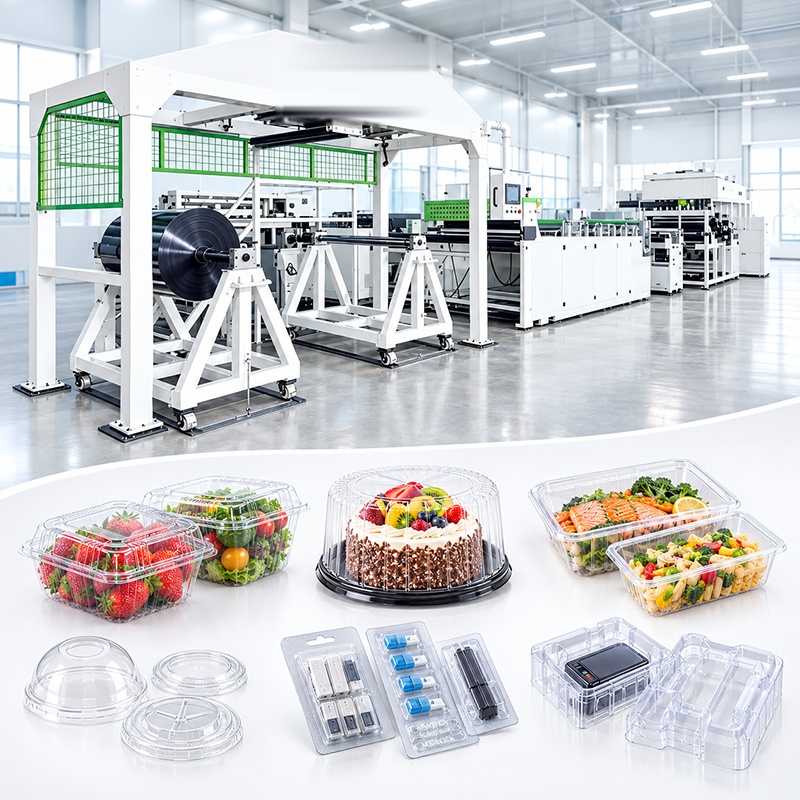
A indústria moderna de termoformação e embalagem exige elevada transparência, resistência à deformação e custos de produção mais baixos. Alcançar estes três requisitos numa extrusora de camada única implica, normalmente, adquirir resina de PET virgem 100%. A linha de coextrusão de folhas de PET de três camadas ABA da TZ-machinery resolve este problema: uma estrutura em sanduíche ABA permite aos fabricantes maximizar o teor de material reciclado sem comprometer o acabamento da superfície nem a conformidade com as normas de qualidade alimentar.
1. O que é uma estrutura de coextrusão ABA?
Num sistema de coextrusão ABA de três camadas, duas extrusoras dividem a folha em três camadas distintas:
- Camada A (superfícies exteriores): películas finas e de elevada transparência, fabricadas a partir de PET virgem ou de aditivos funcionais.
- Camada B (núcleo): um núcleo interno espesso — que pode atingir 70%-80% da espessura total da chapa —, fabricado a partir de PET reciclado (rPET), flocos de garrafas ou material triturado industrial.
Um polímero de baixo custo ou reciclado é encapsulado entre duas camadas exteriores de material virgem, pelo que a chapa mantém uma aparência impecável e um comportamento de selagem suave, ao mesmo tempo que os custos com a resina diminuem drasticamente. Se a sua matéria-prima for constituída principalmente por flocos reciclados, consulte Qual é a máquina de extrusão de PET adequada para o PET reciclado? para a lógica de seleção mais abrangente.
2. Principais vantagens da linha ABA PET da TZ-machinery
Poupanças significativas nos custos das matérias-primas
A introdução de flocos de rPET ou resíduos de fábrica na extrusora da camada B primária reduz substancialmente o custo da matéria-prima. As finas camadas A protegem o núcleo, ocultando a variação de cor e as pequenas imperfeições inerentes ao plástico reciclado. A resina é o maior custo variável na produção de chapas, pelo que é aqui que reside o retorno do investimento – o modelo completo está descrito no nosso Guia de investimento e retorno do investimento (ROI) para linhas de extrusão de chapas de PET.
Resistência à tração e rigidez estrutural superiores
A chapa coextrudida apresenta maior resistência ao impacto e ao rasgo do que a chapa de camada única. A união de três camadas em condições térmicas controladas proporciona uma elevada estabilidade mecânica, o que é importante para a termoformação de alta resistência e para tabuleiros de estampagem profunda.
Conformidade com os requisitos relativos ao contacto com alimentos e elevada transparência visual
No que diz respeito a embalagens alimentares, tabuleiros de fruta e embalagens blister, tanto a segurança como a aparência são aspetos imprescindíveis. As camadas exteriores de PET virgem funcionam como uma barreira higiénica, garantindo que a folha é segura para alimentos e preservando, ao mesmo tempo, a transparência cristalina que os compradores esperam do APET e do PETG.
Controlo preciso da temperatura e da fusão
A dosagem avançada da bomba de material fundido, as cabeças de extrusão automáticas e o controlo de temperatura multizona mantêm a espessura uniforme ao longo de toda a largura da folha. O controlo consistente da espessura minimiza as taxas de rejeição na fase de termoformação a jusante.
3. Principais especificações técnicas
| Caraterística | Especificação |
|---|---|
| Materiais transformados | APET, PETG, rPET (flocos de PET reciclado) |
| Estrutura em camadas | ABA (superfície / núcleo reciclado / superfície) |
| Configuração da extrusora | Extrusora principal (núcleo B) + extrusora lateral (camadas A) |
| Intervalo de saída | 300 kg/h a mais de 1 000 kg/h (dependendo do modelo) |
| Espessura da folha | 0,15 mm – 1,8 mm |
| Aplicações | Embalagens tipo clamshell termoformadas, tabuleiros para alimentos, embalagens blister, caixas dobráveis |
4. Principais aplicações
- Embalagens alimentares: recipientes transparentes com tampa articulada, tampas para bebidas frias, tabuleiros de padaria e cestinhas para produtos hortícolas.
- Embalagens industriais e médicas: embalagens blister para ferramentas de uso intensivo, tabuleiros para componentes eletrónicos e embalagens protetoras do tipo clamshell.
- Qualidade de impressão e dobragem da caixa: folha de PET de elevada transparência para caixas dobráveis e artigos de papelaria transparentes.
5. Perguntas frequentes
Qual é a quantidade de PET reciclado que uma linha ABA consegue processar?
O núcleo da camada B pode atingir uma espessura total da chapa de 70%-80%, pelo que a maior parte do volume da chapa pode ser constituída por flocos de rPET, flocos de garrafas ou material triturado internamente, enquanto as camadas externas virgens (A-skins) permanecem finas.
Um núcleo com elevado teor de rPET continua a cumprir as normas relativas ao contacto com alimentos?
Sim. O contacto com os alimentos é determinado pela superfície, e não pelo núcleo. As camadas A de PET virgem constituem a barreira de contacto, pelo que a folha continua a ser segura para o contacto com alimentos, mesmo com uma elevada percentagem de material reciclado no seu interior.
Que espessuras e rendimentos abrange esta linha?
Chapas de 0,15 mm a 1,8 mm, com uma capacidade de 300 kg/h a mais de 1 000 kg/h, dependendo do modelo e da configuração do parafuso.
Uma linha ABA é melhor do que uma linha de camada única?
No que diz respeito aos custos, sim: a resina é o maior custo variável, e uma linha ABA substitui a maior parte dessa resina por matéria-prima reciclada. Quanto ao desempenho, a chapa coextrudida também supera a chapa de camada única em termos de resistência ao impacto e resistência ao rasgo.
Que materiais pode processar?
Lâminas de APET, PETG e rPET. A extrusora da camada A também pode transportar aditivos funcionais, tais como masterbatch de cor ou anti-bloqueio.
Melhore as suas capacidades de extrusão
Uma linha de produção de chapas por coextrusão ABA PET proporciona aos produtores de grande volume uma vantagem direta em termos de custos: um custo mais baixo da resina por quilograma, sem comprometer a transparência nem a integridade estrutural, o que reduz o período de retorno do investimento. Consulte o Linha de coextrusão de chapas de três camadas ABA PET especificações, ou comparar uma configuração em funcionamento no nosso Linha de produção de chapas de PET de três camadas ABA com capacidade de 800 kg/h caso. Envie os seus valores de produção pretendidos, a largura da chapa e a percentagem de conteúdo reciclado para obter uma configuração personalizada da linha de produção e um orçamento.